
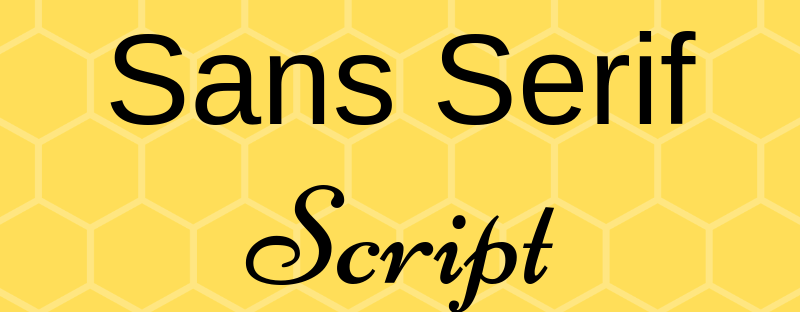
Choosing a font or fonts for your website, social media, or any business related materials can seem overwhelming. There are so many to choose from. Fonts can evoke feelings and help tell others about your brand and business. They can also work against you.
This isn’t a crash course in typography. I’m sharing some general rules of thumb to consider for font selections when you have options. Keeping these tips in mind can help you sort through font choices.
Font Styles
- Script Fonts have a flowing, handwritten appearance that can provide a certain warmth or elegance. They can work well for business names or taglines. However, some scripts are challenging to read. Think about how they will be used and the size and weight of the font in relation to the material it will be used on. You may need to test out several and compare them to know which works best. Just because you love a certain font is not a reason to use it in your business.
- Serif Fonts are often the default on many websites and blogs. Many books are published with serif fonts. They feel stable, strong, and secure because many of the letterforms have “feet” on them. Typically they size up or down well making them clear and readable. Negatives for serifs might be a “feeling” of heaviness or too old-fashioned.
- Sans-Serif Fonts are also quite common defaults. You are reading this blog in a sans serif font. It retains the stability and strength of a serif font without the feet which can mean it feels lighter or more modern to the reader. Sans-serif fonts can feel plain, without the swish of a script or the feet of the serif font.
- Stylized Fonts are those that take a script, serif or sans-serif as a base then accentuate particular aspects of that font until it has become a new font. While it shares some of the characteristics of the base font it stands alone as a font type. These fonts can look sketchy, have shadows, appendages or other additions. Some are very bold and others have a soft, light feeling. Stylized fonts have lots of interest but may be hard to apply for every purpose. You might love a stylized font for your logo, but find you struggle using it for your website or supporting business materials.
Using Fonts Effectively
- Combine two styles for interest. Combining a script font with a serif or sans-serif font can be very effective if used wisely. Many brands do this. With each style playing off the other, there is a distinctive look.
- Limit fonts. Using no more than three fonts is a best practice. It’s even better to stick with two contrasting but complimentary fonts to build a distinctive look that speaks to your brand. A single font used well is also very effective. Getting font crazy on your website, blog, social media, or other materials dilutes your message and can frustrate readers.
- Bold and italic have their place. Bold emphasizes while italic softens. While bold can work well with most, if not all, fonts, italic doesn’t always look great on every font. Do a little experimenting. If everything is bold or italic then their special natures are silenced. Better to use them where they can be effective.
- Size matters. Regardless of the type of font you choose, they all have thresholds. Some fonts when in a large format – think about a banner for a conference sponsorship – go from looking lovely to feeling weighty or cumbersome. More often when fonts get smaller they become unreadable. Script fonts are especially challenging to read in small type size.
- Spacing can also add visual interest. While you may not be able to change the spacing on your webpage or blog, you may be able to do it in your visual posts, logo or branded materials. Spacing changes can be space between l e t t e r s or space between lines of text or a bit of both. Again, experimentation may help you decide which way to go.
Choosing fonts can be fun and frustrating. If you are feeling overwhelmed and need a font consultation, connect with me so I can help you out.

 Busy B Services